On October 29, 2026, Alphabet, Google’s parent company, lost about $500 billion in market value. In a single day. François and I opened our podcast with that number. Not to play prophets, but to ask a real question: is ChatGPT replacing Google? At our agency, the answer already shows in where our new clients come from.
No, ChatGPT is not replacing Google. Not yet. But your customers have started asking it their questions, and most of the new clients who came to us lately found us by asking ChatGPT, Gemini or Claude. Google is still essential for calls, the map and advertising. The right strategy is to be visible in both places: a clear website, the same information everywhere and real content, ideally on video.
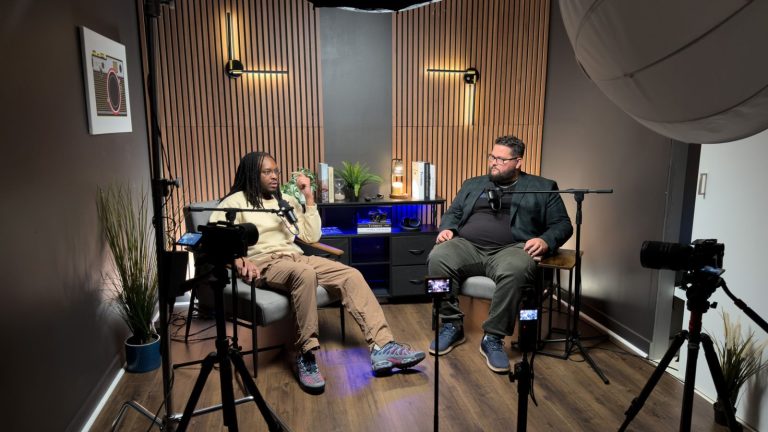
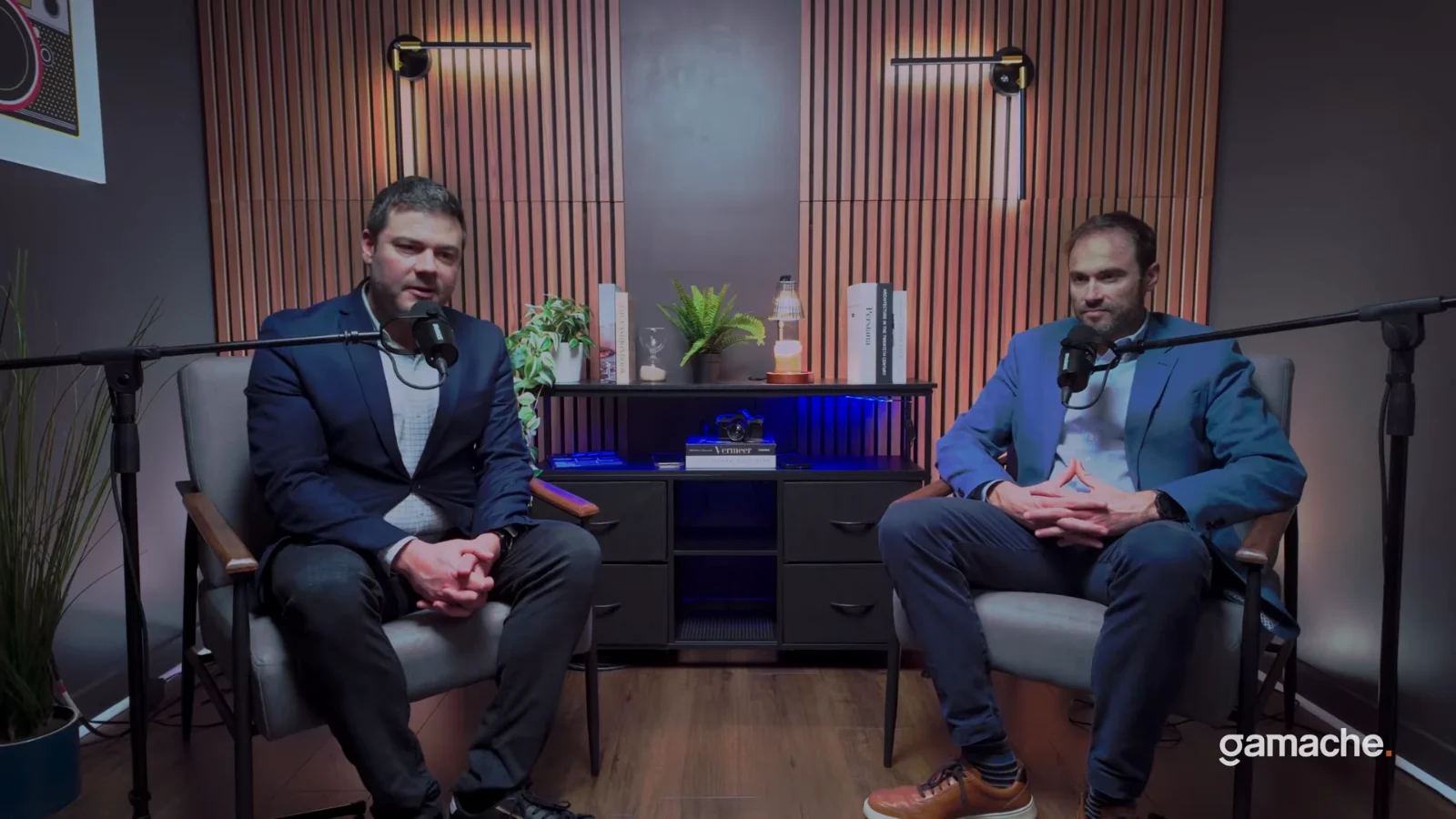
My brother and business partner François and I sat down in front of two microphones to talk about what we’ve been living at the agency for the past year. No script. Just two guys who tore down their business model to rebuild it around AI, and who don’t hide it. The episode is in French; this page sums it up in English.
Episode summary
- Hosts: Olivier Gamache and François Gamache, co-founders of Gamache Média
- Location: our studio in Saint-Lambert
- Format: a free-flowing conversation, no script, in French
- Starting point: Alphabet’s stock drop on October 29, 2026
- Episode: Nos nouveaux clients arrivent par ChatGPT, pas par Google (YouTube, in French)
The core question of the episode fits in one line: is ChatGPT replacing Google, yes or no? Here are our answers to that one and to the other questions we cover, with a link to the exact moment we talk about each of them.
Will ChatGPT replace Google?
Not completely, and not tomorrow morning. But for part of all searches, it has already started, and the stock market noticed.
On October 28, Alphabet released its third-quarter results. Revenue was up. The next day, the stock still fell 12.6%, its worst session since it went public in 2004. What investors punished: a slowing Google Search, and billions invested in AI that are not paying off yet.
My reading, and it’s an opinion: Google is no longer just fighting to stay the search engine. It’s fighting to become the assistant that will do our shopping for us. I’m convinced that in a few years, we’ll spend much less time in front of our screens. We’ll talk, and agents will get things done. That takes data centres, data and people’s trust. Google has all three. The war is only beginning.
For an SME, the takeaway is simpler. Your customers aren’t choosing between Google and ChatGPT. They use both. You need to be found in both places.
Watch this part of the episode (9:55, in French)
Are my customers looking for me on ChatGPT?
More and more, yes. And it’s no longer just young people or tech folks.
Last year, the average person wasn’t looking for a contractor or a lawyer on ChatGPT. This year, they started. We see it in our clients’ reports, because we track where every request comes from.
At Riendeau Avocats, a law firm we’ve worked with since 2018, about one client in five now comes through ChatGPT and other AI tools, based on the lead sources tracked in CallRail. We tell the whole story in our law firm marketing case study.
And at our agency? Most of the new clients who came to us lately found us by asking ChatGPT, Gemini or Claude. Not Google. And they’re generally quality leads. For now, it costs us nothing in advertising. Only time: optimizing the website, creating content, following a recipe.
Watch this part of the episode (11:54, in French)
How do I make my business visible in ChatGPT?
By being clear, consistent and real everywhere AI looks. There’s no magic trick. But there is a recipe.
- The same information everywhere. The same name, address and phone number on your website, your Google Business Profile and every directory. A different address from one directory to the next, and AI starts to doubt.
- A fast, easy-to-read website. If a bot can’t read your page, it can’t cite it.
- Answers to real questions. The ones your customers ask you on the phone, in plain words.
- Real content, on video if you can. More on that just below.
Not sure your information is the same everywhere? Talk to us, we’ll check it with you.
The good news: this work costs much less than it used to. Technical SEO that used to take us 50 or 100 hours now takes a tenth of that. The full method is in our AI search guide, and our article on the new business listings in ChatGPT explains why your Google Business Profile matters more than ever.
Watch this part of the episode (17:56, in French)
Why does video matter so much to get found by AI?
Because everything else is becoming easy to fake. A text, a photo, even a generated video: AI can do it all. What’s becoming rare is proof that you really exist.
That’s the idea behind our move. We left an industrial area of Longueuil for Saint-Lambert, built a studio and hired Paul, who handles content production full time. Our clients need to show, more than ever, that they have real trucks, real employees and real experts.
Riendeau Avocats’ lawyers come to our studio to record their video segments. In a field where clients are scared, a face is reassuring. And AI engines read what is said in videos: in August 2026, YouTube was the most cited platform across eight AI products, including ChatGPT, Gemini and Claude, according to Meltwater data.
Watch this part of the episode (13:12, in French)
Does a blog written with AI still work?
Yes, if you have something to say. No, if you’re rehashing what already exists.
Google spelled it out in February 2023: it rewards quality content, no matter how it was made. What it penalizes is automation used mainly to manipulate rankings. The problem is that anyone can now produce ten articles a day. A text that rewords what’s already everywhere is barely worth anything anymore.
Use AI to write, sure. But bring your point of view, your experience and your answers to your customers’ real questions. That’s what AI can’t make up.
Since we preach transparency: this page was prepared with AI, from the transcript of our episode. The point of view is ours.
Watch this part of the episode (14:54, in French)
Can you advertise in ChatGPT in Canada?
Yes, since spring 2026. But it’s still young.
OpenAI has been showing ads to Canadian users since April 16, 2026, below ChatGPT’s answers. Only the Free and Go plans see them; Plus, Pro, Business, Enterprise and Edu plans don’t. A Canadian business can now buy its own ads in OpenAI’s Ads Manager, still in beta.
When we looked at the platform this year, we could only target Canada as a whole, without choosing the language. For a garage on Montreal’s South Shore, paying to be seen in Vancouver is a strange investment. Targeting options are changing fast, so we check again every time.
My bet: 2027 will be the year OpenAI pushes hard on advertising. There’s too much money at stake. And we’ll be running campaigns directly inside the AI tools everyday people use, the way we run Google campaigns today. For now, the real opportunity is elsewhere: getting recommended for free, without paying for every click.
Information verified on November 16, 2026.
Watch this part of the episode (15:22, in French)
Should I still invest in Google Ads?
Yes. But not only there.
Google Ads is still the fastest way to make the phone ring, as long as someone watches the campaigns closely. At Riendeau Avocats, Google ads generated more than 42,000 clicks and more than 3,000 calls in 2024.
What bothers me is an SME that puts $10,000 a month into Google and nothing anywhere else. That money goes to the United States, and the client doesn’t always see what it brings in. A bit of competition will do some good. Visibility in AI, on the other hand, is built with content you own, and it keeps working when the campaign stops.
Our advice: keep advertising for quick results, and invest in parallel in what makes you visible without paying per click.
Watch this part of the episode (16:31, in French)
Why shouldn’t an agency that uses AI bill by the hour anymore?
Because the hour means nothing when 100 hours of work now take 10.
For years, we ran like a traditional agency: we billed production by the hour. We had good growth years in 2023 and 2024, but there was something like an invisible hand. The bigger we got, the more expenses followed. A project sold at 50 hours took 80. We always ended up breaking even.
So we tore the model down. We use AI openly, we tell our clients, and we lowered our packages. Not out of generosity. Because a client paying 2022 prices for work that now takes a fraction of the time will figure it out eventually. Might as well be honest right away.
As I say in the episode, it’s like selling a $200,000 Mercedes for the price of a $40,000 Kia. The time we save goes back into what matters: strategy, ideas, follow-up. A smaller team, experts, and more clients well served.
And if the cost of AI goes up someday, we’ll adjust. For now, what it costs us is minimal compared to what it saves us.
Watch this part of the episode (9:13, in French)
Frequently asked questions
Where should an SME start with AI?
With its own data. Your emails, your meeting notes, your calls recorded with the client’s permission, your team meetings: that’s gold. Sorted by type of client and pooled together, it becomes the company’s collective memory, instead of each employee using AI in their own corner. What used to cost hundreds of thousands of dollars is now within reach of an SME with 3 or 45 employees. Programs can also help fund the shift: we sum them up in our article on AI funding for Québec SMEs.
Will AI eliminate jobs in my SME?
Some, yes. Denying it would be dishonest. But employers will look for people who can orchestrate AI well, and those who learn now will come out fine. In a professional firm, it can also mean billing targets that are easier to reach, and fewer evenings spent catching up on files.
Where can I watch the episode?
At the top of this page, or on YouTube (in French). Our previous episode, on AI in Québec, is also online.
In short
Google isn’t dead. It just lost its monopoly on the question.
Your customers still search on Google. But more and more, they also ask ChatGPT who to call. The businesses that get recommended will be the ones with clear information, real content and a face. That doesn’t take a multinational’s budget. It takes starting before your competitors.
On October 29, the stock market did the math. Your customers had done it first.
Sources
- Nos nouveaux clients arrivent par ChatGPT, pas par Google | L’IA et les PME, Gamache Média podcast, YouTube (in French), November 16, 2026.
- Google s’écroule : 500 milliards évaporés en un jour, Economie Matin (in French), October 30, 2026.
- Alphabet égare 467 milliards de dollars dans le nuage, Option Finance (in French), October 29, 2026.
- Ads in ChatGPT, OpenAI Help Center.
- ChatGPT Ads availability, OpenAI Help Center.
- ChatGPT Ads Go Live in Canada, Australia, and New Zealand, TechWyse, 2026.
- YouTube led AI-answer citations across 8 engines in August 2026, Relevant Audience, based on Meltwater data.
- Google Search’s guidance about AI-generated content, Google Search Central, February 8, 2023.
- One in five clients now comes from AI: what we did for Riendeau Avocats, Gamache Média, November 8, 2026.
- Gamache Média data: lead sources tracked for the agency and its clients, November 2026.
Sources consulted on November 16, 2026.