

A Montreal law firm, specialized websites for each area of law, ads adjusted within hours and AI search optimization for impaired driving. Here’s what we did for Riendeau Avocats, with the numbers to back it up.
Riendeau Avocats has worked with us since 2018. We split the firm’s services into specialized websites, managed its Google Ads campaigns day to day and built its presence in AI answers for specific searches. In 2024, the campaigns generated more than 42,000 clicks and more than 3,000 calls. Today, according to the lead source tracked in CallRail, about one client in five arrives through ChatGPT and other AI tools.
Engagement summary
- Client: Riendeau Avocats, a Montreal law firm
- Practice areas: criminal and penal law, immigration, family law, traffic tickets
- Client since: 2018
- Scope: practice-area websites, Google Ads, SEO and AI search optimization (GEO), video and social media
- Key result: about one client in five arrives through ChatGPT and other AI tools (lead source tracked in CallRail)
It’s 11 p.m. Someone has just been arrested for impaired driving. He’s sitting in his car, heart pounding, and he takes out his phone. Two years ago, he would have typed “impaired driving lawyer” into Google. Today, he writes to ChatGPT: “I got arrested tonight. Am I going to lose my licence, and which lawyer can help me?”
The answer comes back in seconds. It explains the process. Then it names a few firms. Not ten. A few.
For Riendeau Avocats, this isn’t a hypothetical. About 20% of the firm’s clients now arrive through conversational AI. It’s not a hunch: it’s measured, lead by lead, in CallRail. Here’s how we got there, step by step.
The starting point: one firm, one website
When the firm first approached us, it had 5 lawyers, a single website and a limited presence on Google. The goal was clear: attract better-qualified clients in each practice area to support the team’s growth.
The problem with a single website, for a firm that handles criminal law, immigration, family law and traffic tickets, is that it speaks to everyone at once. And when you speak to everyone, you speak to no one. The person arrested at 11 p.m. isn’t looking for the same thing as a family preparing an immigration application.
1. One website per area of law
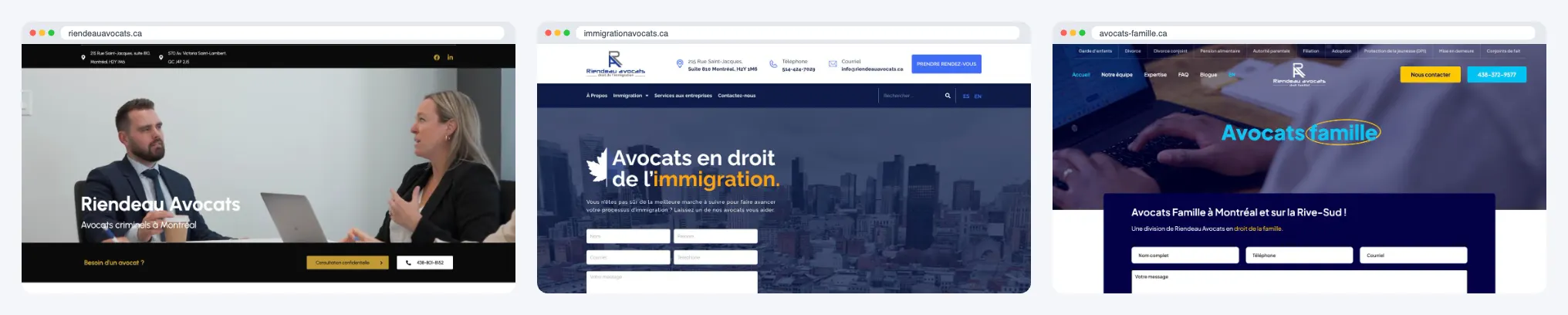
It’s the same idea as in a store: one aisle per need. Rather than putting everything in one place, we built a network of specialized websites, each with a domain name tied to its area of practice:
- riendeauavocats.ca, the firm’s main website;
- mtlticket.ca, for contesting a traffic ticket, with packages you can buy online;
- immigrationavocats.ca, with online appointment booking;
- avocats-famille.ca and riendeaucriminel.ca, with specialized content on family law and criminal law.
Each site answers the questions of a single type of client. It’s clearer for the person searching. And it’s easier to understand for Google and for AI tools, which look for the most precise source for a precise question.
2. Ads that adapt within the day
Separate Google ads for each practice area, adjusted based on the calls and forms received. Results in 2024: more than 42,000 clicks and more than 3,000 calls.
The numbers look good, but what really matters is speed. One day, the firm needed to fill a new lawyer’s schedule. We readjusted the budgets. A few hours later, the phone was ringing more. Within a week, the consultations they wanted were booked. Joanie Chainey, the firm’s general manager, tells the story in her video (below).
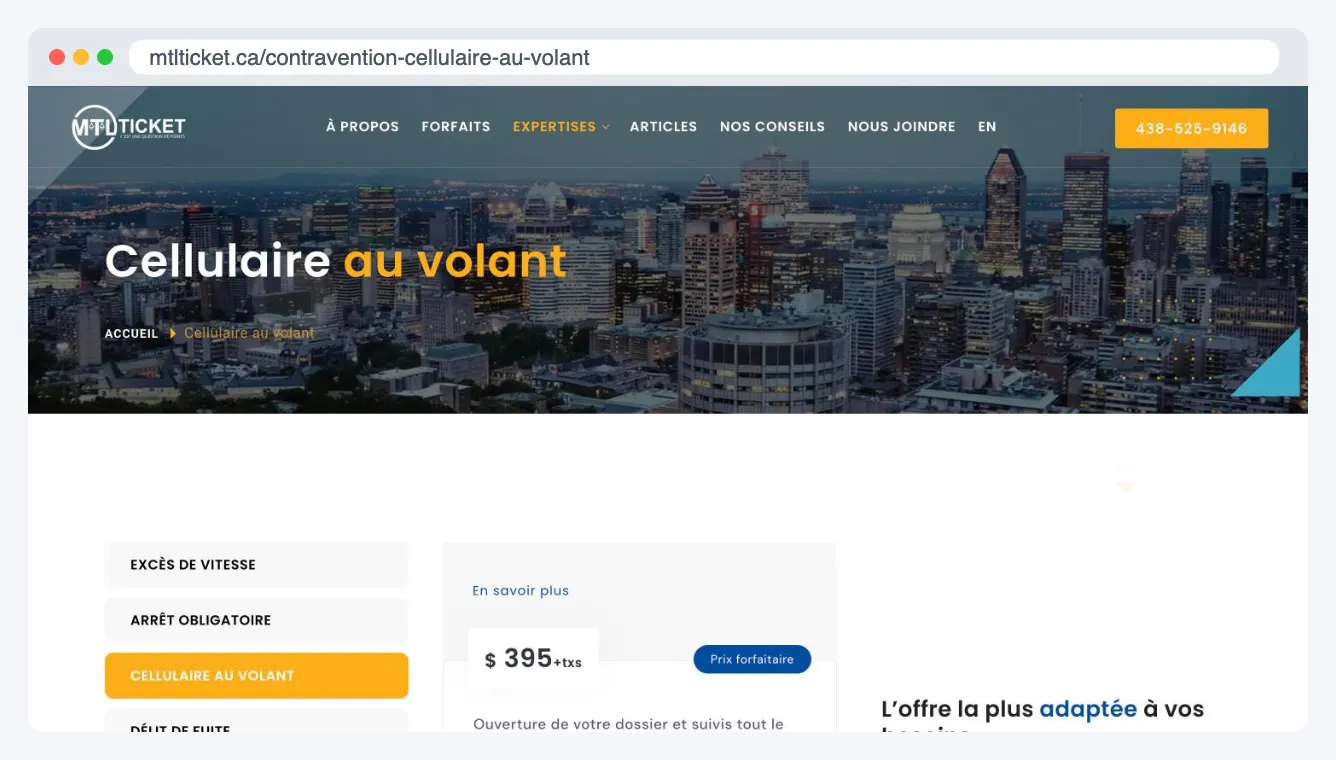
3. MTL Ticket: one page for each offence
On MTL Ticket, each offence has its own page. Someone looking up a specific offence lands directly on the right answer, right when they need it. Not on a general page asking them to “contact us for more information.”
4. AI search optimization: answering the 11 p.m. question
We worked on the firm’s presence for search intents related to impaired driving: the questions people ask in the hours after an arrest. Clear answers that make sense without reading the rest of the page. The same information everywhere on the web. And proof that the firm knows what it’s talking about. In practice, this is our method for AI search optimization (GEO): structured data that tells search engines and AI tools clearly who the firm is, where its offices are and who its lawyers are; articles signed by the firm’s own lawyers; and pages that directly answer the questions people ask after an arrest.
The result, and I’ll say it again because it’s the heart of the story: about one client in five now arrives through ChatGPT and other AI tools. We measure it with the source of each lead in CallRail, the tool that tracks the firm’s calls and forms. Imagine the loss if the AI had named another firm. One client in five, sent elsewhere, without anyone noticing.
5. Video and social media
Video clips and regular posts, with a few targeted campaigns. It wasn’t the main driver of the strategy, but it keeps the firm visible and puts a face on its lawyers. In a field where clients are scared, a face is reassuring.
The results, by the numbers
| Metric | Result | Period |
|---|---|---|
| Clients arriving through AI | About 20% | 2026, according to CallRail |
| Clicks on Google ads | More than 42,000 | 2024 |
| Calls received | More than 3,000 | 2024 |
| Visibility on Google | Up more than 50% | First months of the engagement |
| Team size | From 5 to 35 lawyers | Since 2018 |
Let’s be clear: a firm grows first and foremost because of its lawyers. Our job is to make sure the right clients find them, on Google and in AI answers alike. Other projects, in other industries, are in our work.
What Joanie says
Joanie Chainey, general manager of Riendeau Avocats, in her 45-second video (in French, translated here):
“The first thing that comes to mind is responsiveness. As soon as we have a need, we reach out to the team, and the adjustment or the need is quickly taken care of. For example, we needed to keep a new lawyer busy. We contacted the team and asked for the advertising budgets to be readjusted. It took a few hours and the phone was already ringing more. We could see more traffic on our websites. People were contacting the office and, within a week, we had booked the number of consultations we wanted for her. It’s great to see that when we have a need and something has to be adjusted, we contact the team and it’s done right away.”
And in her Google review (translated from French): “Very satisfied with the services offered and the service received from Gamache Média. The team is proactive and professional! A special mention to Émile and Paul, who are a great help to us on a regular basis.”
What I would do in your place
You don’t need five websites to get started. Here’s the order I would follow for law firm marketing, or for any professional practice.
- Take the five-minute test. Ask ChatGPT, Gemini and Perplexity the questions a client would ask. Are you named? Who is named instead of you? The details are in our article on GEO.
- Write the 11 p.m. question. For each key service, a page that directly answers the question a panicked client would ask. Timelines, steps, what to expect. Not a “contact us.”
- Clean up your listings. Same name, same address, same phone number everywhere: Google Business Profile, directories, the Barreau du Québec, social media.
- Ask how people found you. Add “ChatGPT or another AI” to the choices on your form. Without it, you’ll never know what AI brings you.
- Keep ads that can move. SEO takes months. Ads, on the other hand, can fill a schedule in a week, as long as someone is watching them closely.
Frequently asked questions
How can a law firm get recommended by ChatGPT?
By answering clearly, in black and white, the specific questions people ask: an offence, a procedure, a deadline. You also need the same information everywhere on the web (website, Google Business Profile, directories) and verifiable proof, such as reviews and mentions. That’s what we did for Riendeau Avocats on impaired driving.
Do you need a separate website for each area of law?
Not always. For Riendeau Avocats, specialized websites made it possible to speak to one type of client at a time and to rank better in each area. For a smaller firm, clearly separate sections on a single website can be enough.
How long does it take to see results?
Google Ads bring in calls almost right away: when the firm asked for more consultations for a new lawyer, the phone was ringing more within a few hours. SEO and AI search optimization, on the other hand, are built over several months.
In short
Riendeau Avocats didn’t bet on a magic trick. The firm bet on clarity: one website per type of client, one page per question, ads that follow the office’s needs, and solid information that AI can repeat without getting it wrong.
Someone looking for a lawyer at 11 p.m. doesn’t read ten websites. They call the first one that clearly answers their question. Our job is to make sure that’s you.