
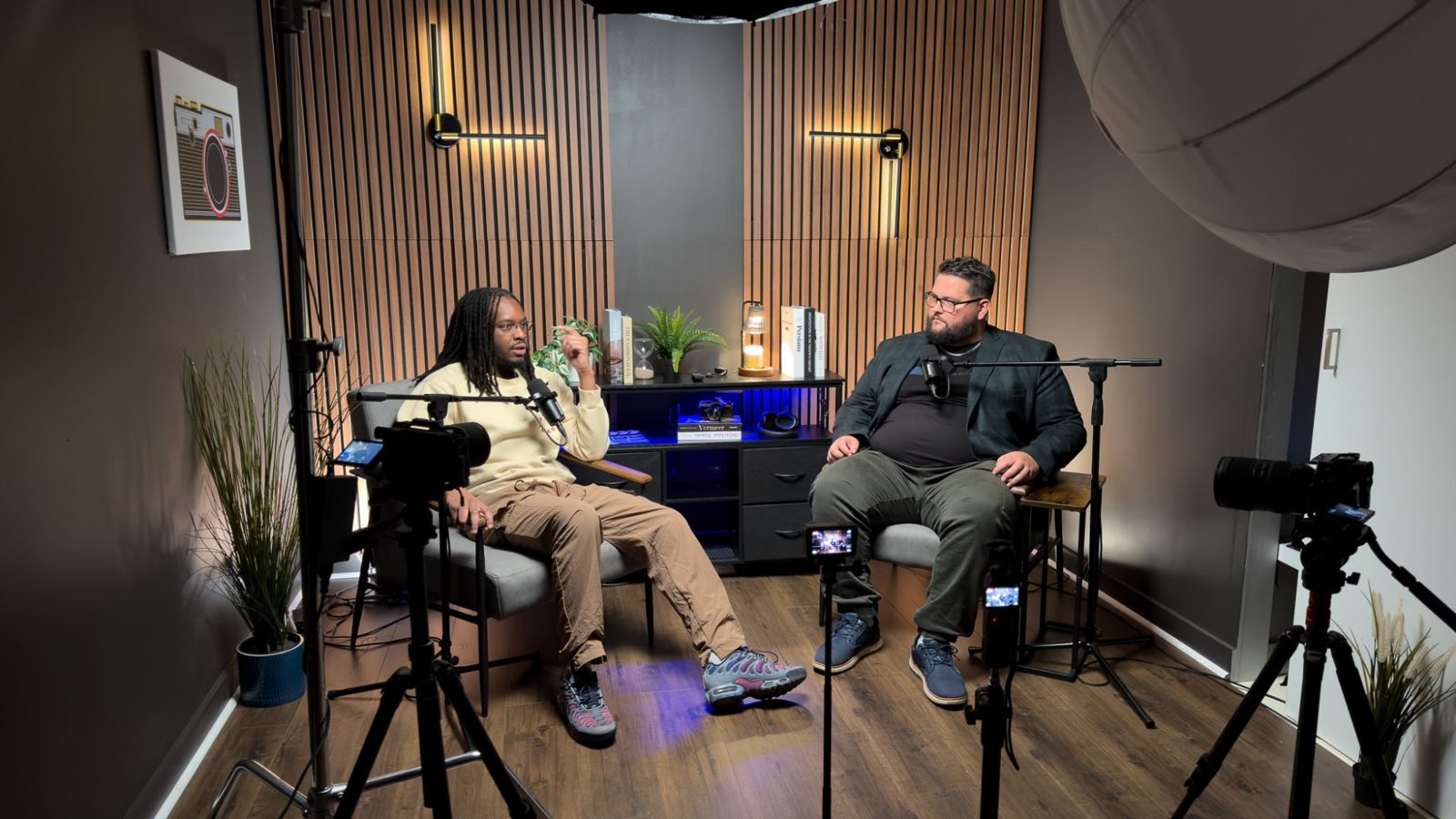
On November 6, we set up three cameras in our studio in Saint-Lambert and let Émile and Yannis talk about AI, unscripted, with one question in the background: where does Québec stand? Yannis even blanked out halfway through, and we kept it in the full cut.
When it comes to AI, Québec is starting from behind, and waiting for things to settle down is not a strategy. AI doesn’t replace people: it changes their role, taking over routine tasks to free up time for what matters. For us, that means a video edited in a week instead of two months, and better follow-up for our clients. Yes, it’s scary. That’s exactly why you need to start testing it now.
Episode summary
- Guests: Émile Dumont, director of operations, and Yannis Sika, AI developer
- Recorded: November 6, 2026, in our Saint-Lambert studio, with three cameras
- Format: an open conversation, no script
- Starting point: Gemini 4 Carbon, Google’s new model
- Episode: watch it on YouTube (in French)
The starting point was Gemini 4 Carbon, the new model Google had just announced. Since it isn’t open to the public yet, we hadn’t been able to test it. The conversation quickly moved on to things we deal with every day at the agency. Here’s what I took away from it.
A new model every week
Things are moving so fast it’s almost funny. A model comes out, you read the benchmarks, you tell yourself you should try it, and the next one is already here. Émile summed it up well: you have to talk about it right away and test what it can do as quickly as possible. That’s what we’ll do with Carbon as soon as we get access, and we’ll report back in an upcoming video.
What we built in-house
Yannis talked about a very concrete problem we had. Each of us had our own AI account, with its own memory. Émile’s assistant didn’t know what Yannis’s was doing, or mine.
So we centralized our data and our processes. If someone goes on vacation, the rest of the team can pick up their processes, their research and the way they work. It sounds technical, but for a small team, it changes everything.
Yes, it’s scary
Yannis said it plainly: it’s exciting to watch AI evolve, but it’s also starting to get scary, because we don’t really know its limits.
“If it’s not us, it’ll be someone else.”
Émile Dumont, director of operations
That was Émile’s answer, and it’s the one I agree with most: it’s scary, but we have to test AI and push it further. Québec is lagging behind other countries. Funding programs are starting to appear, like BDC’s LIFT program, and I wouldn’t be surprised to see more soon. We’ve also rounded up what’s open right now for Québec SMEs. But if we wait too long, the gap will become very hard to close.
“It will never replace a human”
I asked the guys a question. Every time I talk about AI, someone tells me it can never replace a human. The last time, it was someone who runs an agency with a lot of employees. In their view, a team like ours will never be able to do the same work, because the human side will always be missing.
Émile doesn’t accept the premise. For him, AI doesn’t replace people: it changes their role. We become conductors. The tool handles the routine tasks, which frees up time for strategic work, for the human side, in fact.
“Using AI to get more human results: that’s the reality.”
Émile Dumont
In practical terms, for a client, that means better follow-up and shorter turnaround times.
Fast, without the “AI slop”
The best example is video. Some places take two months to edit one. For us, it’s often a week.
Many people still think AI means the generic content they see scrolling by on social media. When you master the tool properly, the result is thoughtful, and it stands out. What makes the difference is how you use it. That’s how we approach content creation for our clients.
Jobs, and school
I understand the fear of losing jobs. Émile sees two possible paths. Either we lose jobs, or we increase our capacity, with more businesses getting started. A sharp person can now learn in a few months what used to take five or ten years. And in Québec, right now, few people are starting businesses.
That led us to talk about school. In high school, AI is often banned. Émile isn’t in favour of using it 100%, but he doesn’t agree with banning it outright either. There would be ways to offer courses on how to use it well. According to him, that’s already happening in China, and the countries making progress right now are the ones going all in on AI.
The full episode
To watch the whole conversation, the episode is on our YouTube channel (in French).
What about you?
I don’t claim we have all the answers. We’re learning along with everyone else, by testing. But I’m convinced of one thing: waiting for things to settle down is not a strategy.
The question we asked at the end of the episode, I’ll ask you here too: how is AI going in your business? Write to us, we really want to know.
Sources
- Google, Gemini 4 Carbon: our next frontier model (October 28, 2026).
- BDC, BDC Launches LIFT: Getting Canadian SMEs off the AI sidelines (April 24, 2026).