Nine real estate projects, for rent and for sale, from the Laurentians to Gatineau. Here are the challenges that come up every time, and what we learned solving them.
A new real estate project rents or sells faster when four things are in place before the first ad: a brand people remember, a clear website that answers the real questions, targeted advertising in the right area at the right time, and someone who follows up on every request until the signature. The rest is execution. And that’s often where things go wrong.
Before founding an agency, I spent more than twelve years in retail. Twelve years watching customers come in, touch, hesitate, leave. I took away one thing, just one, that has followed me everywhere: customers don’t buy what you show them. They buy what they manage to picture in their own home.
Now try that with a building that doesn’t exist yet. No countertop to touch. No floor to try out. A lot, a construction fence, and a developer swearing it’s going to be beautiful.
That’s the job. For a few years now, our team has handled real estate marketing for developers, for rent and for sale, from the Laurentians to Gatineau and from the North Shore to the South Shore. Here are the nine challenges that come up on every project. Unfiltered, mistakes included, ours too.
Selling or renting what doesn’t exist yet
Let’s sum up the problem. You’re asking someone to sign a lease, or sign for a house, on a building they can’t visit. They won’t see the living room light at 4 p.m. They won’t run into the neighbour. They have to take your word for it.
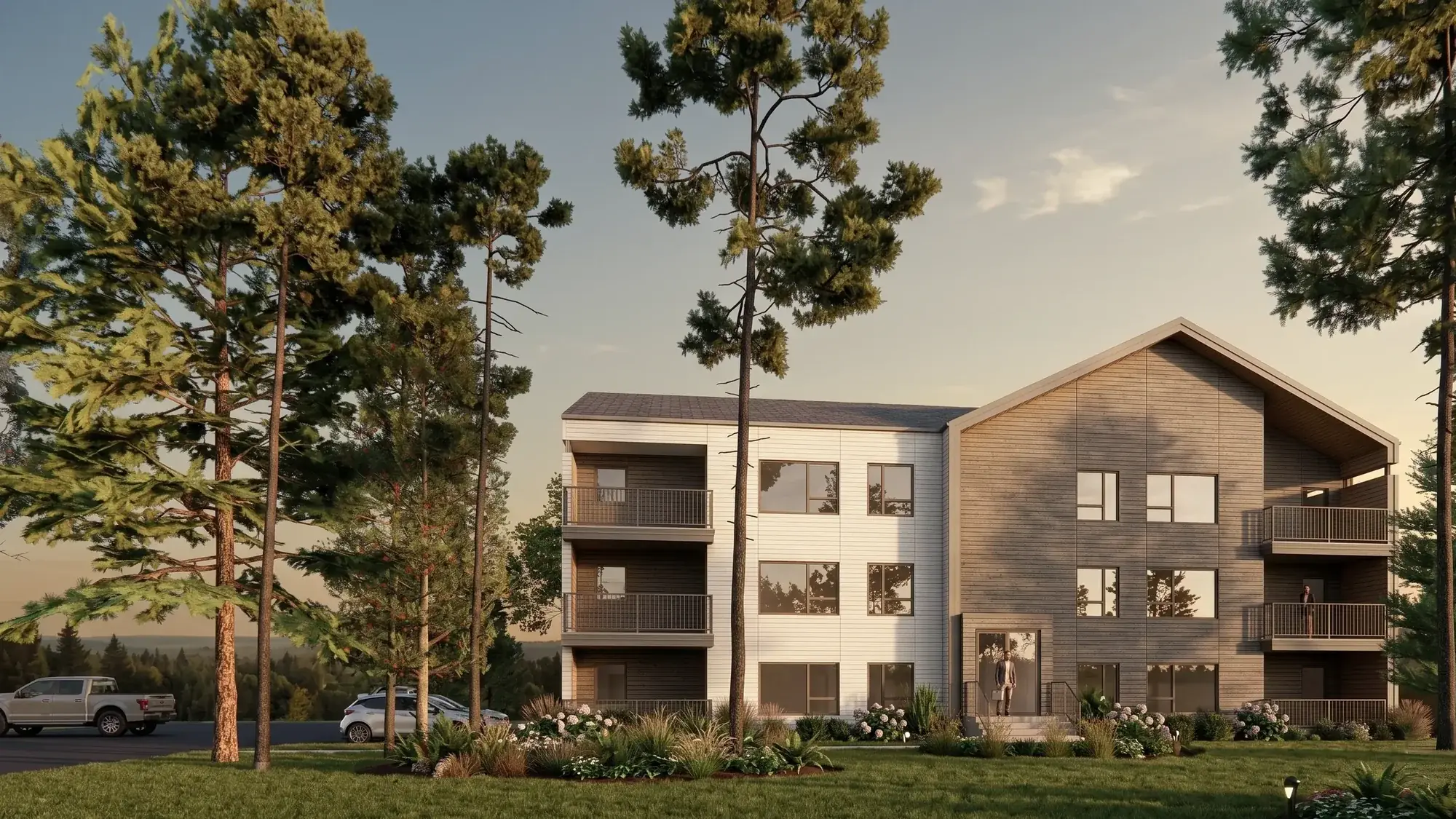
So your marketing has only one job: replace the visit. 3D renderings, floor plans, square footage, the neighbourhood description: these aren’t decoration. They’re your salespeople.
For Scola, six new apartments in downtown Mont-Tremblant, we reused a recipe born at Canopée Développement (more on that just below). The website is a scrolling tour: you enter the building, move from room to room, then land on the floor plans and availability. A visit, without the work boots.
The detail I didn’t see coming. It was the developer himself who asked us to add “visuals for illustration purposes only.” He was right. The 3D rendering shows a nice shelf at the back of the kitchen; the tenant will be looking for it on moving day. The more beautiful your visuals, the more that little sentence is worth.
Canopée Développement: the first immersive website
Scola’s scrolling tour isn’t our first. The very first one, we built for a builder in Val-David. And it was born from a challenge.
Sébastien, the founder of Canopée Développement, builds custom homes and tiny houses in the Laurentians. In spring 2026, he had been preparing his new concept for a year. At our meeting in May, he gave us carte blanche. With an implicit but very clear condition: surprise me. Think outside the box.
With our young team, we took him at his word. The result: a website where the visitor comes down from the clouds, arrives in front of the house, walks into the living room and steps back out onto the lot. Not a video that plays by itself. It’s the visitor’s thumb, or mouse, that moves the tour forward.
Why was this impossible three years ago? Not because nobody had thought of it. Because an animation like that, frame by frame, would have taken hundreds of hours. And no developer in their right mind puts that kind of budget into a website. They keep their money for advertising, and they’re right to: a project’s media budget is already heavy.
What changed is the tools. Animating 3D renderings, producing the sequences, coding the scroll effect: with artificial intelligence, we’re now talking weeks, not months. The immersive website became realistic. For the first time, a developer can afford the “wow” effect without sacrificing their advertising.
The safeguard we set for ourselves. I told Sébastien from the start: it has to be spectacular, but not to the point of losing people. Not all of his buyers are 25. So there’s always a way out: a menu, buttons, more classic pages for those who just want the price and the floor plan.
At our May meeting, after seeing the first concepts, he told us: “I had set the bar high in my expectations, and you exceeded it.” And in July, looking at the site in action: “It’s mind-blowing.”
Canopée was our lab. Scola and Le Bétulas followed. Thank you, Sébastien, for pushing us.
Challenge 1: nobody searches for the project name
On launch day, everyone is proud. The project has a name, a logo, a website. There’s just one small detail missing: nobody in the world types that name into Google. Except your mother. And the neighbour next to the lot, wondering what you’re building.
That’s roughly what I was explaining to the Terrasse des Pionniers team in Mont-Blanc in November 2025. Their Google Business Profile was verified, and their website already came up for the project name. Well done. But a future tenant doesn’t search for “Terrasse des Pionniers.” They search for “new 4½,” “rental apartment,” “rental condo,” with the name of their town. (In Québec, a 4½ is a two-bedroom apartment.)
Why pay for advertising at the start? Because SEO works, but it takes months. Meanwhile, you’re competing with every major rental listing site in Québec. Good luck. Google Ads puts you in the results from the first week, on specific searches.
And the nice Facebook page? It starts from zero. The first followers are your brother-in-law, your subcontractors and two or three curious people. Not your future tenants. Posts are there to show the construction is progressing. To reach the right people, you need targeted advertising on Facebook and Instagram.
The mechanism that works. Google Ads brings in people who are actively searching. Then, a Facebook and Instagram ad follows up with those who visited the site without leaving their contact information. You know, the ones who are “going to think about it.” We help them think about it.
Challenge 2: launching at the right time
Launching too early is expensive. Launching too late costs months of rent. In between, there’s a window, and it isn’t the same for every tool.
For Scola, in June 2026, we made a decision that always makes hurried developers frown: wait. The website and the logo were ready. We still held off advertising until the permit and the start of construction. As long as there’s nothing on the lot, you’re paying to attract people who can’t picture themselves there yet. In other words, you’re paying for nothing.
The order we settled on, and now apply almost everywhere:
- the project website, complete, with its real information;
- the Facebook and Instagram pages;
- posts showing the project taking shape;
- paid advertising, once there’s a link to click and a construction site to show.
Forget the groundbreaking. Everyone wants to film the ceremony. I get it: there are white hard hats and smiles. But let’s be honest, a hole in the ground doesn’t make anyone dream. A drone video while the framing goes up, on the other hand, stops the scrolling thumb.
And watch the calendar. In rentals, everything happens from January to March, before the July moves. If your delivery falls in the summer, winter is when you need to be visible. Not in spring, when everyone has already signed elsewhere.
Challenge 3: target local, not wide
The reflex is always the same: “Let’s cover all of Greater Montréal, more people will see it.” It’s logical. It’s also almost always a mistake.
Google Ads works by auction. Put $100 on too wide an area and you’ll be a little visible everywhere, so really visible nowhere. You’ll be competing against every apartment in Laval to attract someone who was looking in Mont-Tremblant. That makes a lot of clicks. It makes few leases.
For Terrasse des Pionniers, it was the developer who put us back on track, and he was right. His future tenants, he said, would mostly be people already in the region: people who had settled for an apartment the year before, for lack of choice, and who wanted something new. So we aimed tight. Sainte-Agathe, Mont-Tremblant, Mont-Blanc, Labelle. People aged 30 and over.
My rule, which sometimes makes people wince. We start local, with a reasonable budget, around $1,000 a month for a regional project. We only widen if requests are lacking. Putting more money in from the start doesn’t bring in more. It just wastes more.
Knowing who you’re talking to changes everything. For Scola, future tenants are mostly families: the building is a short walk from every school in Mont-Tremblant, from elementary to high school. That changes the ad copy, the photos chosen and the towns added, like La Conception and Labelle. You don’t sell a 4½ to a family the way you sell it to a young professional.
Challenge 4: a clear website beats a pretty one
I say this as someone who has been building websites since 2001: a beautiful website that leaves visitors in doubt loses the request. Visitors want four answers in thirty seconds. What type of unit? How much? When? How do I book?
The best lesson on this doesn’t come from us. It comes from a developer. On the first version of the Terrasse des Pionniers website, we presented the two buildings, 973 and 977. He looked at the screen and hesitated. Him. The guy building them. The two buildings were identical; what people are looking for are 4½ and 5½ units. We rebuilt everything around unit types, with prices, square footage and floor plans.
The five-second rule. If the developer, who knows his project by heart, hesitates in front of his own website, imagine a stranger on their phone, on the bus. Have someone who doesn’t know the project look at your website, without explaining anything. That’s exactly what the Scola team did with its partners. It’s free and it’s the best test there is.
Contradictions kill trust. On that same website, one page said “pets allowed.” Another, “no pets.” So which is it? The real answer: the owner wants to meet the pet and its owner before saying yes. We wrote “pets allowed under certain conditions.” It’s true, it’s clear, and it makes the phone ring.
Answer before they call you. The same questions come up at every visit: appliances, parking, lease length, the credit check. Every answer written on the website is one less call for your team and one less hesitation for the tenant.
Challenge 5: promotions that backfire
A free month to attract the last tenants. On paper, it’s a good idea. In real life, it lasts until the day your first tenants find out.
It happened to one of our clients, and the story deserves to be told. A tenant already living there sees an ad for an apartment in her own building. Cheaper than hers. She says nothing. Instead, she asks an acquaintance to call and check, like in a good detective movie. Then she demands the same discount.
In a small building, everything gets out. Always.
The problem isn’t the promotion. It’s the unfairness. A tenant who feels cheated in the first year becomes your worst advertising, and they live in your building.
What we recommend now:
- time-limited promotions announced as such, like “the January promo” for those who sign in January;
- a clear, written rule, the same for everyone;
- a perk rather than a rent discount, when possible: Internet included the first year, a parking spot, an appliance;
- fair starting rents, rather than inflated prices that are quietly lowered later.
A well-managed promotion creates urgency. An improvised promotion creates mistrust. And mistrust can’t be refunded.
Challenge 6: selling lots, a different trade
Renting a 4½ and selling a high-end lot are not the same sport. It’s like comparing a game of softball with a marathon. In rentals, the decision is made in a few weeks. For a lot where the buyer will build the house of their life, it takes months. And a lot of coffees.
With Prestige Terrebonne, wooded residential lots on the North Shore, we understood we had to sell three things at once.
A possibility, not a lot. People were calling to ask whether they could build themselves. When the same question keeps coming up on the phone, it’s not the customer who’s distracted. It’s the website that isn’t answering. Self-building has to be written in big letters, right at the top of the page.
A dream, not a legal document. A cadastral plan has never made a heart beat faster. The developer was right to want renderings with mature trees, a lived-in street, the project’s waterfall. Buyers need to see their future home. Not a vacant lot with an orange stake.
The real obstacles, named honestly. The building permit delay and the taxes on a vacant lot make people hesitate. We don’t sweep them under the rug: we answer them in the FAQ and help buyers plan. An obstacle you name reassures. An obstacle discovered at the notary’s office, much less so.
Never inflate sales. The developer refused posts that exaggerated the number of lots sold. Hats off to him. In this business, buyers always end up checking, and false urgency destroys in a week the trust it took months to build.
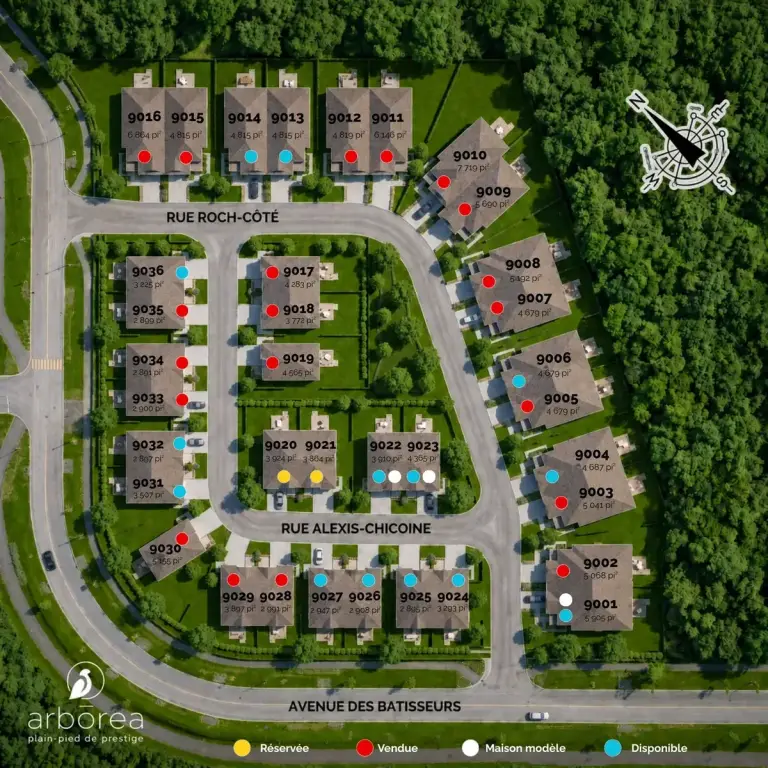
Transparency sells. For Arborea, in Sainte-Julie, the neighbourhood map shows in colour the lots sold, reserved and available, and the model homes. It’s the best social proof there is. Buyers see that others chose before them. And above all, they see what’s left.
Challenge 7: don’t lose a single request
The most brilliant ad in the world is useless if the request lands in an inbox nobody opens. It’s the least glamorous challenge on the list. It’s also the one that costs the most when ignored.
The typical case. When we took over the marketing of a lot project, the forms went straight to the broker. How many requests came from Google? From Facebook? From word of mouth? A mystery. So it was impossible to know which ads were paying off. We were driving at night with the headlights off.
What we set up on every project:
- every form and every call comes in with its source: Google, Meta, SEO, AI or the sign on the lot;
- requests go directly into the developer’s CRM, as for Groupe Grilli Samuel;
- a short weekly report, with the list of requests and what became of them;
- a single measure that really counts: the cost of a signed lease or a closed sale.
Why that measure? Because the number of clicks doesn’t pay your mortgage. After a few signatures, you can say how much advertising budget it takes to rent one unit. From there, every decision becomes simple: increase, decrease, or change the area.
The silly detail that costs weeks. Access. The project emails, the Facebook page, the ad account, the Google Business Profile. We’ve seen launches delayed by several days because only one person had the security code on their phone. Sort that out before launch. Not during.
Challenge 8: the website and the ads on the same team
I’ll be direct, even if it upsets a few colleagues. When one agency runs the ads and another controls the website, nobody can guarantee results. The ad brings someone to a page. If the page doesn’t speak the same language as the ad, the person leaves. And everyone points at the other.
Take an ad promising “new 4½ units, Internet included.” The visitor clicks and lands on a home page telling the developer’s story since 1987. They close the tab. What they needed was a page that repeats the promise word for word, shows the unit and offers a button to book a visit. Period.
That’s why, for Le Cirius, rental condos in Gatineau, we designed the campaign landing page ourselves, with the downloadable brochure. The Google Ads campaign and the page were designed together, like the two hands of the same pianist. The project filled up.
Timing depends on it too. If the ads are ready but the other supplier delivers the page in six weeks, you’ve just missed your season. In rentals, missing January to March often means waiting a year.
One team, one story. The name, the logo, the colours, the website, the sign on the lot, the ads and the videos must tell the same story. For Le Bétulas, Scola, Terrasse des Pionniers, Le Cirius and Canopée Développement, we created the brand before anything else. For exactly that reason.
Challenge 9: being ChatGPT’s answer
Your future tenant no longer just types “4½ Mont-Tremblant” into Google. More and more, they open ChatGPT and ask: “I’m looking for a new apartment near the schools in Mont-Tremblant, what are my options?” And then the machine chooses who it names. You, or the neighbour.
This isn’t science fiction anymore. According to a national Rentals.ca survey of 1,194 renters conducted in spring 2026, 28.5% had already used tools like ChatGPT or Gemini to find a place to live. In Québec, it’s 22.7%, a little behind Toronto. In other words: the wave is coming, and there’s still a small head start to take. (source)
And it’s not just a young people’s thing. People aged 25 to 34 lead, yes, but nearly one in four renters aged 65 and over uses it too. For new rentals in the regions, that’s exactly your clientele.
The number that should wake you up. Among renters who tried, about one in five say AI didn’t help them, notably because of outdated or inaccurate listing information and neighbourhood descriptions lacking local nuance. In other words: if the information about your project is vague, contradictory or impossible to find, AI will describe it badly. Or worse, it will talk about another project.
Sébastien, from Canopée, summed it up better than I could during our meeting: people don’t want a teacher. They want to fall in love on the website, and when they want information, they’ll look for it themselves, in ChatGPT. So his website focuses on emotion. And the detailed information, the kind AI will read and cite, needs to exist somewhere, clear and up to date.
How AI chooses who it cites:
- clear facts: unit type, price or “starting from” price, inclusions, move-in date, neighbourhood;
- the same facts everywhere: website, Google Business Profile, social pages, listings. One contradiction, and AI hesitates;
- an FAQ that answers the real questions, written the way people ask them;
- useful content around the project. For Canopée, we even proposed a separate information website on the new law governing tiny houses: when a law suddenly gets hundreds of searches a month, the first to explain it well becomes the source everyone cites, AI included.
We apply the same method, which we call GEO, or AI search optimization, in other sectors. At Riendeau Avocats, a criminal law firm, about 20% of clients now arrive through AI. Real estate is simply catching up with the rest of the world.
Renting or selling: what changes
Both require a brand, a clear website and close follow-up. But make no mistake: the pace, the message and how you measure success have nothing in common. A quick reference.
| Comparing | Rental project | Project for sale (houses, condos, lots) |
|---|---|---|
| Decision time | A few weeks | Several months |
| What the customer wants to see | The unit, the rent, the inclusions, the move-in date | The model, the lot, the price, the neighbourhood, long-term value |
| Area to target | Local: the town and neighbouring towns | Wider, depending on the buyer profile |
| Peak season | January to March, before the July moves | Spring and fall |
| Key message | “Brand new, close to everything, available on this date” | “Your future home, right here” |
| Trap to avoid | Unfair promotions between tenants | False urgency and inflated sales |
| The measure that counts | Cost per signed lease | Cost per closed sale and time to sell |
| Our projects | Le Bétulas, Scola, Terrasse des Pionniers, Le Cirius | Arborea, Canopée Développement, Prestige Terrebonne |
Real estate marketing strategy: a typical timeline
Every project has its own rhythm, of course. But if you want a recipe, here’s the order we follow most often for a rental project delivered in summer.
- 12 months before delivery: the brand. The name, the logo, the colours and the tone. It’s the foundation for everything else.
- 10 to 12 months before: the basic presence. The domain name, the project emails, the Google Business Profile, the sign on the lot with a 3D rendering.
- 9 to 10 months before: the project website. Unit types, floor plans, prices or “starting from” prices, inclusions, the neighbourhood and an FAQ.
- 8 to 9 months before: the social pages. Facebook and Instagram, with progress posts.
- At the permit and start of construction: advertising. Google Ads in the local area, then remarketing on Facebook and Instagram.
- During framing: content that makes people dream. Drone videos and short clips with the developer.
- From January to March: the push. The year’s biggest budget, when people are shopping for their next home.
- The last units: precision. Ads on the remaining units, a well-managed promotion if needed, then the budget goes down as the project fills up.
- After: the next project. This project’s website, brand and data become the starting point for the next one. That’s exactly what happened from Terrasse des Pionniers to Scola, then to Le Bétulas.
The developer’s checklist
Before putting a single dollar into advertising, take five minutes and check these off. If a box stays empty, that’s where your money will leak.
- The project has a name, a logo and a consistent brand.
- The website presents the unit types, with floor plans, square footage and prices or “starting from” prices.
- No information contradicts itself from one page to another (pets, inclusions, parking, dates).
- 3D renderings carry the note “visuals for illustration purposes only.”
- Someone who doesn’t know the project has looked at the website without any explanation.
- The project’s Google Business Profile is verified and placed in the right spot on the map.
- The sign on the lot points to the website.
- The advertising area is defined, starting local.
- Every request comes in with its source, into a CRM or a tracked list.
- Someone answers requests the same day.
- Access (emails, Meta, Google) is shared and tested.
- The promotions policy is written down and the same for everyone.
Frequently asked questions
When should you start marketing a new real estate project?
The brand and the website, about a year before delivery. Paid advertising, from the permit and the start of construction, when pre-leasing or pre-sales open.
How much should you budget for advertising for a rental project?
For a regional project, we often start around $1,000 a month, mostly in Google Ads, then adjust based on the number of signed leases. This media budget is paid directly to Google and Meta, on top of the agency’s fees.
Isn’t SEO enough?
Not at the start. It takes several months for a new website to rank for searches like “new apartment for rent.” Advertising delivers results right away, while SEO is being built.
Do you need a separate website for each project?
In most cases, yes. A dedicated website speaks to a single type of buyer or tenant, ranks for the project’s name and town, and is easy to measure.
Do people search for apartments with ChatGPT?
More and more. Assistants like ChatGPT, Gemini or Perplexity cite websites that clearly answer questions: price, location, inclusions, availability. So a clear website is also your best asset for being recommended by AI. We cover this in more detail in challenge 9.
In short
We like to believe a well-located project rents itself. It doesn’t. It rents when people manage to picture themselves there, find their answers without having to call, and get a quick reply when they call anyway. The rest is luck. And luck is not a strategy.
Terrasse des Pionniers, in Mont-Blanc, is the example I cite most often. Twenty new apartments in a Laurentian village. All rented, and quickly. The same developer then entrusted us with Scola, then Le Bétulas. In business, I don’t know of a better compliment than a client who calls you back for the next project.
Sources
- REMI Network, based on a Rentals.ca survey, AI adoption surges among Canadian renters (August 2026)
- Gamache Média’s experience with developers and builders in Québec, 2025-2026